
In an era where your next employer, admissions officer, or professional collaborator can learn more about you in 30 seconds online than in a 30-minute interview, your digital footprint has quietly become one of the most influential storytellers in your life. Every post you share, comment you leave, and search result tied to your name contributes to a narrative—one that decision-makers are absolutely reading.
The question is no longer whether they’re looking (they are), but whether what they find strengthens or sabotages your ambitions. In a world where online presence has become a new form of currency, intentionally curating your digital identity isn’t vanity, it is strategy, and it’s becoming one of the smartest career and academic readiness moves you can make.
The Rising Stakes of Social Media in Decision‐Making
Recruiters and admissions officers increasingly view social media as a critical lens into a person’s character, judgment, and potential fit.
- According to ZipDo’s 2025 report, 73% of companies have successfully hired a candidate through social media, and 41% of employers have rejected candidates because of their social-media content.
- A survey by WIFitalents found that 92% of recruiters use social media channels for hiring, and 65% use it to assess cultural fit.
- Indeed’s data (via HRD Australia) reveals that 77% of recruiters are reviewing social media, and alarmingly, 96% said they would reject a candidate based on content they see there.
- From the academic side, Kaplan’s survey reports that 28% of college admissions officers say they actually look at applicants’ profiles, even though a larger share (67%) believe it’s “fair game.”
- Further, surveys indicate that 70% of admissions officers use platforms like Instagram or Twitter to evaluate personality and engagement, and 42% found something that positively impacted an applicant’s chances through social media.
What these numbers tell us is clear: decision-makers are scanning more than your resume. They’re gauging soft skills, values, behavior, and how you present yourself when you think no one’s watching.

Why Your Digital Footprint Is Your Silent Brand Ambassador
- Authenticity Signals: Your posts, interactions, and overall voice online reveal more than what’s on your CV. Thoughtful commentary or community engagement can demonstrate leadership, intellectual curiosity, and emotional intelligence. Recent academic research even suggests that machine learning models can infer soft skills and personality traits from social media behavior.
- Risk Management for Decision-Makers: Employers and admissions officers both want to minimize risk. A poorly framed post or a questionable photo can raise red flags about judgment or maturity.
- Visibility & Opportunity Generation: A curated presence can amplify your reach. Engaging with your industry, sharing your work, or participating in relevant conversations helps you become visible to recruiters and admissions committees alike.
- Gap Filling & Narrative Building: Maybe you don’t have years of work experience, but your digital footprint can reflect your interests, your values, and your growth trajectory. Many admissions officers look at social media for leadership, volunteerism, or intellectual engagement.
The Risks of Ignoring Your Online Legacy
If you think, ‘I don’t have much out there, so what could go wrong?’ Think again. Decision-makers may interpret a sparse or inconsistent online presence as a lack of initiative, engagement, or even transparency.
On the riskier end, problematic posts can quietly sway decisions. One study found that 57% of admission officers encountered content that negatively impacted a candidate’s chance for acceptance (MoldStud).

Taking Control: How to Curate with Purpose
Here’s how to proactively shape your online identity for real-world impact:
- Audit Regularly: Conduct a periodic inventory of your digital footprint—what appears under your name on Google, LinkedIn, Instagram, TikTok, etc. Look for red flags or conflicting messages.
- Align and Clarify: Decide what story you want to tell. Are you a thought leader in your field? An aspiring academic? A socially conscious professional? Align your posts, interactions, and network around that narrative.
- Balance Private vs. Public: Use privacy settings when needed, but don’t hide completely. A public profile (especially on LinkedIn) signals transparency and professionalism.
- Engage Thoughtfully: Share insights, not just memes. Comment on relevant conversations. Publish your own mini-essays or reflections. The goal is to reflect purpose and perspective.
- Clean Proactively: Remove or archive content that no longer reflects who you are or who you aspire to be. For more sensitive or difficult-to-manage content, consider deeper remediation.
Introducing DigitalDiveSM: Your Digital Footprint Guardian
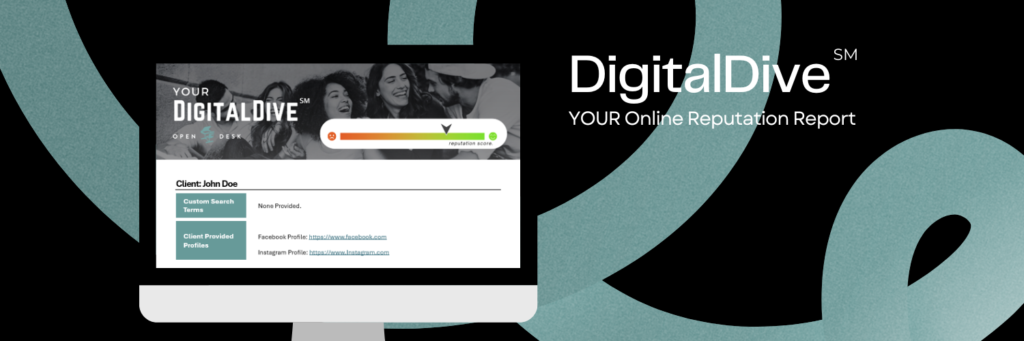
This is where a service like DigitalDive can be a game changer. DigitalDive specializes in helping individuals proactively uncover, assess, and manage online content that could influence how recruiters, employers, or admissions officers perceive them. But more than that, DigitalDive doesn’t just show you what exists—it helps you understand what the world sees and how to strategically shape that narrative.
Reputation Scan: Bringing the Full Picture Into View
DigitalDive deploys advanced tools to surface deep or obscure content you might not know exists—old social media posts, forgotten blogs, tagged photos, online articles, public databases, and even posts associated with name variants.
This level of visibility is powerful because it reveals the actual first impression your audience encounters. Once you know what they see, you can shape what you want them to see next. The scan becomes the raw material for curating a stronger, more aligned digital identity.
Risk Assessment: Understanding What Matters Most
Not all content carries the same weight. A five-year-old meme might be harmless; an inflammatory comment or questionable photo might not be. DigitalDive helps you distinguish what may be minor liabilities versus serious risks, prioritizing what needs to be addressed immediately and what can be managed over time.
This clarity helps you tailor your online presence with strategic intent—removing, editing, or counter-balancing content in ways that strengthen your narrative rather than leaving it to chance.
Tailoring Your Online Presence With Purpose
DigitalDive empowers you to:
- Align your visible identity with the narrative you want decision-makers to see.
- Create a cohesive cross-platform presence that signals maturity and professionalism.
- Boost the content that reinforces your strengths.
- Proactively address anything that could undermine your credibility.
- Develop a fresh, intentional digital strategy built on real data.
In short, DigitalDive empowers you to take ownership over your story: to create a digital legacy that helps, not hurts.
Why Thoughtful Digital Curation Is a Leadership Move
Curating your digital footprint isn’t just about avoiding pitfalls—it’s a leadership mindset. It signals that you are forward-thinking, intentional, and aware of the modern dynamics of trust and reputation. In a crowded professional or academic field, those qualities set you apart.
By actively crafting your online narrative, you don’t just respond to the landscape, you influence it. And by doing so, you send a powerful message: you are not just a consumer of digital channels, but a steward of your own story.
Final Thoughts
Your digital footprint is an asset. When you treat it with strategy and care, it becomes a force multiplier for your career ambitions. Thoughtfully curated, your online presence can speak on your behalf long before you walk into an interview, send an application, or step into a new role. And with a service like DigitalDive in your corner, you can rest assured that you’re proactively managing that presence, rather than reacting to something you didn’t even know was there.
In the digital era, your reputation is real, but it doesn’t have to be out of your control.